Monday, September 17, 2012

Understanding the Monty Hall Problem

Previously I talked about how our intuitions are not so great in the context of classical physics, but this is hardly the limit to what we haven't the best intuitive understanding of. In the world of statistics and probability, our intuitions really are not great, and one classic example of this is the Monty Hall problem.

What is it? Suppose you are on a game show (hosted in this case by Monty Hall of Let's Make a Deal), and there are three doors labeled 1, 2, and 3. Behind two of those doors is a goat, but behind one of them is a new car. You want to win the car, but you only have a 1 in 3 chance of guessing the right door.

Here is where things get interesting. You pick one door which remained closed, and Monty will show you one of the remaining doors has a goat. Monty then asks you if you want to choose the remaining door. The question is: do you stay, which the other door, or does it not matter at all?

When this was posed, most people have the intuition, included well educated people, that there is no benefit to switching. After all, if there are two doors left and one of them has the car, there is a 50/50 chance it is behind either the door you chose or the remaining one, right?

There are apparently a number of nuances about how the question is asked, but these pieces of nuance ultimately matter because of what other information it gives the game show contestant, and the way it is set up here has the surprising results: you ought to switch to the other door; your chances of winning double.

Why is this? Suppose you take Door 1 as your first pic (it doesn't matter which so long as the car is equally-probable behind any of the 3 given doors), you can have two sets, doors picked and doors not. The set of doors picked has one member (Door 1), and the set of doors not picked has two members (Doors 2 & 3). That means the probability that the car is in the second set (doors not picked by you) is 2/3, while the probability of the first set (doors you did pick) is 1/3. Now, when Monty shows a door with a goat (say Door 2), it is from the second set of doors (the ones you did not pick), meaning he shows one member of that set is not the one with the car; this does not affect the set of doors you picked. The probability of either set having the car is still the same, but now you know one member of the second set is not the correct one, while only one member remains. Thus, that remaining member of the second set (Door 3) has a 2/3 probability of having the car, while your first choice of the door (Door 1) still has a 1/3 chance. Thus, you are twice as likely to get the car if you switch rather than stay put.

Crazy, it seems. It also means that if we did this with 100 doors, you picked one, and Monty revealed goats behind 98 of the 99 remaining doors, the chances of getting the car by switching is 99/100, way more likely than if you stayed. And all because Monty gave you more information about the set of doors you didn't pick.

The Wikipedia page also gives other proofs, such as the use of the decision tree as well as more formal proofs, but the set format I used seems the most helpful, at least to me. If you still feel like there is some trickery, this has been also verified empirically:
You can see from this computer sim now the probabilities asymptotically reach 2/3 (66.7%) and 1/3 (33.3%) respectively. You can try out a simulation as well.

But as one last bit of fun, let's see what we get using a Bayesian approach. Bayes' theorem is as follows:


P(A|B) is the probability A is true given B evidence, P(A) is the initial probability A is true, P(-A) is the probability not-A is true (or probability A is false), P(B|A) is the probability of seeing evidence B given A is true (same applies for P(B|-A)). We have the rules that P(A) + P(-A) = 1, and all probabilities must be between 0 and 1. So, what are the numbers? (Another treatment is given here, but I think my method may be a bit easier to understand for this example).

Well, P(A), the prior probability before we have Monty open any goat doors, is 1/3, and the probability of P(-A) is necessarily 2/3. Now, evidence B is the opening of a door with a goat. So, P(B|A) should be 1/2 because the goat would have been behind either one of the remaining doors given we picked the right door from the start (that is, A is true). P(B|-A), on the other hand, is 1. Why? Because if the car is behind one of the doors you did not choose, then the unopened door must have the car (remember, P(B|-A) is the probability of having a goat behind a door if in fact the car is behind one of the doors not chosen). 

Put that all in, and you find the probability of staying with the initial door is 1/3 (P(A|B) = 1/3), and the probability of winning by switching is 2/3 (P(-A|B) = 2/3). So now we have two proofs, and one using Bayesian methods.

And I push Bayes' theorem because it is so powerful and will need to be used more and more in the sciences to make sure we draw proper conclusions. But the debate between Bayesians and Frequentists must wait for another post.

Sunday, September 16, 2012

YouTube Copyright Issues -- Fair Use

So I'm having some trouble with the video I uploaded the other day of my talk about aliens. As many have learned, YouTube is in an odd legal position because people can and do upload copyrighted materials by people who do not own the copyright. Obviously, if I was to upload a video I did not make but I try to profit from it, that is all sorts of wrong, both legally and morally. But there are also points when you should be allowed to use another's material without their express permission. The most obvious way is with parody and commentary/criticism (some useful comments can be found here, including statements in my favor when using clips). I'm doing more of the latter in my talk, so I will focus on that.

If I had to have express permission to use the materials of another person to criticize it, you can see an obvious issue: that person probably doesn't want to have that criticism of their work out there, so giving them the power to stop critics from using their material becomes a method of censorship (something creationists have done, for example). And there is legal provision for this under the Digital Millennium Copyright Acts (DMCA). In the legal code 17 UCS Section 107, this considers the nature of the work, and there is the understanding of Fair Use. There is a lot of legalism to it, but one thing generally recognized is the use of materials for commentary/criticism. For example, there are websites pretty much devoted to critiquing movies, such as at That Guy With the Glasses. Such Internet shows could not exist without the Fair Use clause.

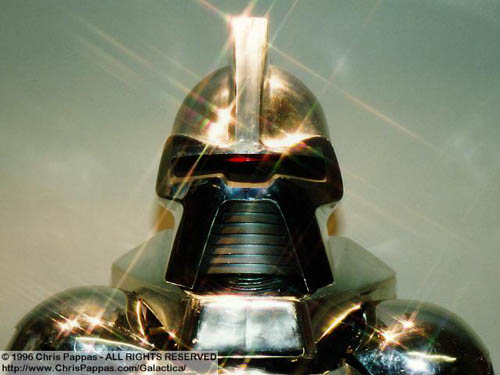
Now, in my presentation, I use a bit from the opening of the original Battlestar Galactica (1978), namely the part about how some believing ancient humans may have descended from people from other planets, peoples that may still fight for survival beyond what we know. Since my presentation was about ancient aliens, including in popular culture, I believed this to fall under Fair Use. However, YouTube has an automated system for finding copyrighted materials.

Obviously the algorithm YouTube uses is great for copyright holders; the work is done for them in finding materials they own so they can make sure their property is not used without proper provision. However, the automatic nature of the system means two things: it can make mistakes, and it does not consider the context it is in. That's a significant problem. On the first part, I had uploaded a video about the Star of Bethlehem as used in Zeitgeist, and YouTube said it used copyrighted materials. However, it did not say what material was copyrighted, and the company I had never heard of (La Red, I just double-checked). Best I could tell, YouTube claimed I used materials from a Chilean TV network, though I didn't use anything in Spanish, and the music was public domain.

So I appealed that copyright claim. And how does this work? They send the claim to the company/owner that YouTube says owns the material, and that company decides if in fact I violated their copyright. Oh, WOW is that a lot of power given over to copyright owners, and that makes both censorship and taking another video maker's money away. La Red could have held to the copyright claim, and any ads on my video would have given money to them rather than to me who made the video. This had happened to one person recently; he recorded some things in his backyard along with bird song, and YouTube identified the sounds as a song from the company Rumblefish. This was difficult since there was no song used by the video maker, other than the ambient bird song. So that video maker make a counterclaim, but Rumblefish still claimed one of their songs was being used without permission! One could call that a lie in order to make profit. However, the Internet spoke, and Rumblefish said they made a mistake and lifted the copyright claim.

Mistakes can be made, but it is strange nonetheless to give the prosecuting party the power to also declare guilt. That is so contrary to how a courtroom is: in the above example, Rumblefish should have been the prosecutor, the video maker the defendant, and there would need to be some other entity as judge and/or jury. But Rumblefish was judge and prosecutor, and obvious conflict of interest, especially when no party was wronged except for the defendant.

Now, in my case, the company La Red responded faster than the YouTube team, and more helpfully. In about a day's time, La Red let go of any copyright claim. I only wish I could thank them for being so honest and efficient.

But now I have a new copyright issue, and this time with a company I do know: NBC. As I mentioned, I used part of the opening to BSG 1978, and here things are not so cut and dry and the examples I gave. Indeed, NBC owns the copyright on BSG 1978, I used the opening to that show, and the content match by YouTube was correct. So that part of the process is not at fault at all. So now I have written a copyright counterclaim, stating how my video about ancient aliens falls under Fair Use. This has now been sent to NBC, and someone there has to decide if in fact I fall under Fair Use. Again, YouTube is giving all the power to the copyright holder in judging Fair Use. I doubt NBC will hire a thousand lawyers to check every complaint sent their way for Fair Use, so more likely some clerk or secretary will have to watch some bit of my video and make a quick decision (poor bloke, by the way). In the mean time, I cannot monetize that video (which is looking to become one of my most trafficked), and I have a strike against my account; too many strikes, and I am gone from YouTube (and perhaps other legal trouble?).

So I am in the hands now of NBC. I can't say how they will judge things, though I think I am in the right. My clip is about 30 seconds out of a over one hour video, and the clip is part of the presentation for commentary and criticism. If I may say, I doubt I reduced the number of views of BSG 1978, and from the audience I showed the clip to it was generally unknown, so if anything I should have increased the number of views of the show (in case you haven't seen the original Battlestar Galactica, it's on Netflix and very entertaining; the new series is also awesome; go watch it now!).

By your command.

Let's see what happens in the next few days, though NBC has until mid-October to decide. That means fewer monetizable views, but I suspect most of the views will come later; it's not like my talk has gone viral. And I still don't know if other copyright claims will come up with my video, especially from ancient astronaut evangelists (again, I claim Fair Use). Again, we'll see.

Saturday, September 15, 2012

Ancient Aliens? My Presentation

Previously I had blogged about various evidences provided for ancient aliens, such as the Nazca Lines, the Baghdad battery, the Piri Re'is map, and the pyramids. I also gave a summary about the methodology of ancient astronaut proponents. But all this was to give some flavor of my presentation.

Quite fortunately, the video of my talk that I gave for the SSA at OSU is already up. You can watch it now.


UPDATE: Had trouble using the BSG opening bit, so here is the video re-edited to avoid that.


And yes, that picture with Jill Tarter did include me. I had a great time working at the SETI Institute back in the day. Also, since she has retired, Gerry Harp is now the head of the institute's research, and he was my adviser when I worked with him as an REU student.

Remember, the SETI Institute is funded solely by private donations. Consider supporting their work. They are doing the archaeology of the future!

So, what are your thoughts?

Friday, September 14, 2012

Ancient Aliens? The Pyramids

As I mentioned in my previous post, I gave a talk about trying to find aliens while also examining the claims of those that promote the hypotheses of ancient astronauts. In the prior posts I went into the details of several things that I didn't have time to adequately mention in my talk, but a comment I received made me realize that it would be a lapse if I did not talk about the construction of pyramids, especially those in Egypt, since these are the go-to objects that ancient astronaut, Atlantis builder, reptilian believers first point to in making their case.

I wasn't going to blog about this subject since I discussed it a fair bit in my talk, but that it not online yet (hopefully it will in the next day or so), and nonetheless this deserve attention. After all, the Great Pyramid at Giza is the only standing Wonder of the World! I should talk about it just for that reason. But instead I have to talk about how it has been abused. And as everyone knows, every time someone says another civilization built the pyramids, a baby Egyptian cries. (Come of von Daniken; think of the children!)

Now, the big claim (in more ways that one) is that the pyramids of Egypt seem to pop out of nowhere without some prior advancements; we went from living in caves to building super-structures, or so it seems. Moreover, we find pyramid structures all over the world, so the Egyptians obviously didn't build them all. This apparent explosion in technical ability thus indicates a greater civilization as the force that made them pop up on the Giza plateau.

And here is where we see that ancient alien enthusiasts are rather similar to Young Earth Creationists: they ignore the transitional forms! (HT to Thomas Verenna for this and more)


The development of Egyptian burial sites and buildings spreads over centuries, starting with simple burial mounds, and then working up to a more formal structure, the mastaba, which were used by the early pharaohs. From there, the idea of the stepped pyramid isn't a great leap; it's basically stacking up mastabas. One of the earliest stepped pyramids (27th century BCE) was for Pharaoh Imhotep (whose name should be familiar from the movie The Mummy (1932 & 1999). From here, the proper pyramid form is desired, in part because it looks better (gotta look good for the afterlife!), and finally we get the pyramid into the form we know and love (some construction details here).

It becomes even more apparent the humanity in making these structures when we look at several, chronologically progressing examples. First, there is the pyramid at Meidum, started in the 3rd dynasty, but was attempted to be finished by Pharaoh Sneferu who founded the 4th dynasty. And it wasn't a success, but instead the pyramid collapsed during construction. You can see in the image layers of limestone and of mud brick, and the step form is also apparent. However, the design had serious flaws, including having the outer layers built on top of sand rather than rock (as at Giza), so we have the collapse except for the core.

This obviously didn't make Sneferu happy, so he built another one, the Bent Pyramid. Again, the picture shows some interesting features. The rocks that make up the bricks, for example, are not well-shaped and makes the work seem slipshod. Perhaps because of this, the engineers had to change the angle of the pyramid midway through construction to avoid another collapse. This is starting to look like trial-and-error rather than a master plan from aliens, doesn't it?

But again, Sneferu wasn't going to rest his immortal soul with such a structure, so he commissioned yet another pyramid. Here, he finally builds the Red Pyramid, which still stands and looks a lot like that at Giza. And one should expect similarity to the major Giza pyramid since it was built by Sneferu's son and successor, Khufu.

So, already the pyramids of Egypt should seem a lot less mysterious. There is at least a century between the stepped pyramid and the Great Pyramid at Giza, and plenty of intermediary forms. To quote what people who evolution know say: We have the fossils, we win!

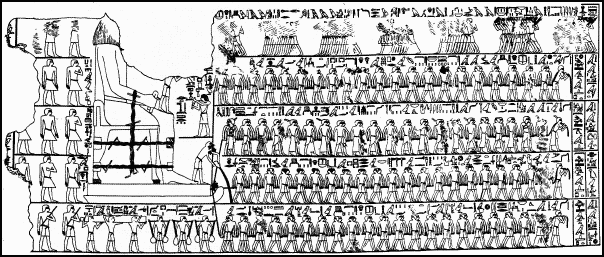
As for moving the pyramids, that's isn't so mysterious either. Sure, it seems hard to fathom that people moved 2.5 million blocks of stone, each weighing tons. But when we actually look at what the Egyptians show us, we see that the great rocks and statues were moved with a lot of back-breaking labor.


What they used was a sledge with dozens of people on ropes. No tractor beams, no anti-gravity projectors, just hard work. They also did pour a lubricant in front of the sledge as well, as is seen in the picture above, using either water, milk, or some oil. This would reduce the friction and the chances of the sledge catching fire because of the heat of pulling. And this isn't the only way they did it. Rollers are also likely used, and the wood would be either locally harvested or imported from places such as Lebanon. Again, all within the technical limits of a Bronze Age civilization, and nothing is given to indicate aliens or Atlantians.

But what about all the other pyramids in the world, such as those in Mesoamerica? Why so many similar structures around the world? First, it should be noted that these pyramids were built thousands of years apart. The Pyramid of the Sun, for example, is built sometime around 100 CE. That is about 2500 years after the Khufu pyramid, a non-trivial difference in time. Aztec and Maya pyramids are younger still. These pyramids also serve different purposes. While the Egyptian pyramids were primarily for burial of dead royalty, the Aztec used the pyramids for human sacrifice rituals, making it a sort of stage performance for all to see. That can be see in the very design of the Aztec pyramids: they have a flatter top for people stand and be seen as if on the top of a grand stage or pediment. So, there is not one culture responsible for these buildings as they have significantly different designs and purposes.

But why pyramids nonetheless? This is actually a sign not of a civilization being super-advanced and needing aliens to explain, but it shows the limitations of the technology of the time. This is because without reinforcing materials, such as iron, the only large structure you can build is a sloping pile. All else can't handle the weight unless the pressure continuously spreads out, just like what a pyramid does. And after all, if a civilization came from another planet, would you really expect them to build things out of rocks rather than advanced materials? Why are aliens making structures less advanced than our own? Or even the Romans who had concrete and iron?

Once we place pyramids in their proper historical context, we can see that they are an amazing accomplishment, but also a human accomplishment. And we really should appreciate it as that, an amazing bit of human ingenuity. All else seems insulting to our ancestors and to us. We should celebrate, not speculate.

Thursday, September 13, 2012

Ancient Aliens? Summary

Later today I will be giving a talk for my local freethought group (SSA OSU) about extraterrestrials. But I want to before then give out info related to it, especially that concerning the ideas of aliens having come to earth in the distant past. So as part of that, I'll blog about a few interesting things that won't be adequately discussed but deserve attention. (Previous entries here and here and here.)

With the previous entries, I tried to show that the evidence for the particular structures or artifacts either were not what they were claimed to be by alien astronaut promoters, or the context of those items was far better explained as what we expect from humans.

The Nazca Lines: Not great as an alien space port, but it seems to best fit into local water deity beliefs and rituals. Not high-tech, probably not astronomical, but what we expect from humans with certain religious/social traditions.

The Baghdad Battery: Probably not actual a battery, and even if so it's far too low a voltage to be alien tech. Most likely it was an accidental combination of materials, and there is no evidence that such a device was used, nor that there was the know-how to have this technology. Since there is no evidence of the use of electricity at the time, nor do we find needed things such as wires for electricity to get passed around, we likely don't have something technologically out of place.

The Piri Re'is map: Rather like other maps of the time creating continents based not on ancient knowledge by philosophical musings. Doesn't actually show the continent of Antarctica, and the only way it does is if you change it to fit your conclusions. This is a case of the eye of the beholder getting in the way of what is really there.

There are many, many more things that could be pointed to and talked about, such as the moai of Easter Island, the structures at Nan Madol, Tiwanaku, and of course the Giza pyramids. However, there is a pattern that emerges all too quickly from how all this is argued by ancient astronaut folks: with a minimum of context and information about the given items, could aliens be a possible solution? Logically, there is not a contradiction in aliens built X, but possibility is a far and long shot away from probability. As Bible scholar F.C. Baur put it, "Anything is possible, but what is probable?"


The case is really made by innuendo: suggest the possibility but do nothing to substantiate it. No real research is done to see if the facts actually fit the alien hypothesis against another. And even when counter-evidence is provided, it is either ignored or some dance is done to try and circumvent it. That can be seen in how von Daniken dealt with criticism as seen in this documentary decades ago:


And it's the same today, and I will show that to some degree in my talk as well. So, if you were expecting me to find ETs this way, that won't be happening. There are much more likely avenues to discovering life outside the earth, both with robots like Curiosity and with SETI. But I will have to explain how later.

Wednesday, September 12, 2012

Ancient Aliens? The Piri Re'is Map

Later this week I will be giving a talk for my local freethought group (SSA OSU) about extraterrestrials. But I want to before then give out info related to it, especially that concerning the ideas of aliens having come to earth in the distant past. So as part of that, I'll blog about a few interesting things that won't be adequately discussed but deserve attention. (Previous entries here and here.)

There are numerous artifacts that ancient astronaut researchers will look to in order to bolster their case. Some of it is unusual iconography, sometimes it is a seeming bit of advanced technology (such as the Baghdad battery discussed previously), and sometimes an object demonstrating knowledge ahead of the time it existed in.


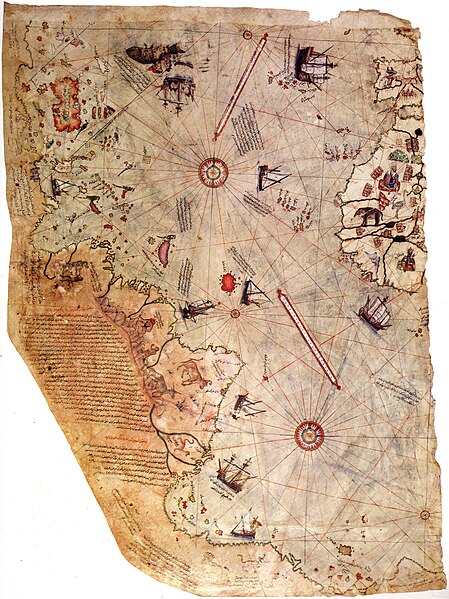
One popular item is the Piri Re'is map, drawn up in 1513 by the Turkish admiral Hacı Ahmed Muhiddin Piri, or Piri Re'is (Re'is being a rank equal to that of captain.) It shows the coasts of Europe, North Africa, and parts of the New World. For 1513, that isn't so extraordinary as it's two decades after Christopher Columbus revealed to Europe the existence of the Americas. But at the southern part of the map, there is an oddity many have pointed to. There is some sort of landmass below South America. Perhaps it is the continent of Antarctica?

This would be remarkable since Antarctica was not officially discovered until 1820. But the more interesting claim comes from Charles Hutchins Hapgood who had a Master's degree in medieval history from Harvard. According to Hapgood, the map actually shows Antarctica as it appears without ice; that is, the map shows the landmass, not the visual cover of the water. That is remarkable since Antarctica has been ice-covered for thousands (actually millions) of years.

In the hands of ancient astronaut folks, this means that either the knowledge comes from ETs millions of years ago or a civilization with radar systems to map out the land rather than just the ice. Hapgood had different theories, including ancient human civilizations and fast-moving continents, but it still relies on the beliefs of what the Piri Re'is map shows.

But how good of a fit is the map to reality? Does it really show Antarctic landmass? We must first wonder if the mapmaker had access to great cartographic information since there are numerous mistakes for the continents known at the time. For example, the map mislabels Cuba as Hispaniola, which would be modern-day Haiti and the Dominican Republic, and apparently only half of the island is known. There are duplication of the Amazon River in South America, along with 900 missing miles of the continent's coastline. But closer to the area of interest, there is no gap between South America and "Antarctica", the Drake Passage between Cape Horn and the Antarctic Peninsula. That is already some serious issue with the map if it is from advanced civilizations, human or otherwise.

If we look at the region specified as a good match between the map and the continent, we are supposed to look at Queen Maud Land (highlighted in reddish pink). 


How strong of a resemblance do you see between this region and the map image above? Doesn't look all that great to me. But here is the glue that held Hapgood's theory together. Already Hapgood had the idea that the ancients had mapped out this part of the world, and at a time when there wasn't ice covering the continent (or at least at the coasts). But with time the accuracy of the maps would be lost. So, given sufficient corrections, we can find that the map does fit the coast of Queen Maud Land. In other words, it's circular reasoning! (See also David C. Jolly, "Was Antarctica Mapped by the Ancients?," The Skeptical Inquirer Vol. 11 (Fall, 1986), pp. 32-43, 55.)

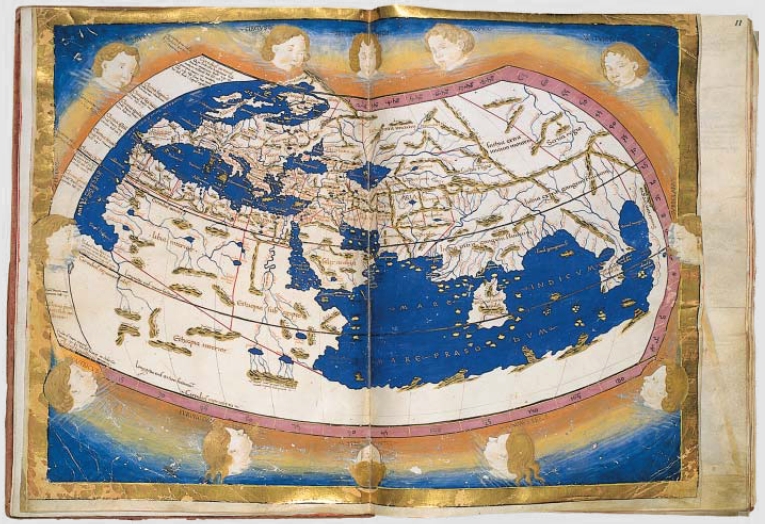
So the fit isn't great and mostly artificial. If anything, we may think that the continent in the south is an extension of South America, an understandable error for the 16th century. But this is not the only map with a southerly continent. In fact, the idea goes all the way back to antiquity. The notion seems to first crop up with Aristotle, and that region came to be known as Terra Australis, meaning southern land (the name is now effectively borne by Australia). The idea Aristotle had was not because of his excellent geographic knowledge, but rather an argument from symmetry (see Meteorology, Book 2.5). His argument is not about observations or old lore, but what the world must be like, given symmetrical notions and the winds. Hardly what we expect if the ancients had such knowledge. The Greeks and Romans also speculated if anyone actually lived below the deserts of North Africa, and so the maps of the time, such as that of Ptolemy, would incorporate the idea. Renaissance maps and globes would also include the continent, but wildly off from what we know today as correct.


Renaissance reconstruction of Ptolemy's map of the world (from his Geographia). Notice the landmass at the south of the Indian Ocean.

A c. 1570 map by Abraham Ortelius. Antarctica had been putting on some weight it seems.
A 1604 Chinese Map. Obviously Terra Australis is a bit larger than what we know to be true. Perhaps there has been super-global warming?
Once we place the Piri Re'is map in its historical context and do not add to it with undue imagination, it's not a spectacular revolt against all modern scholarship. It is one more example of ideas that had been floated around since antiquity based on philosophical speculations. Moreover, it doesn't fit to the real continent of Antarctica with or without ice, so it cannot support either ancient astronaut of Atlantis-like civilization hypotheses. And if these maps came from aliens, then good riddance because they suck as map-making.

Oh, and if you think the problem is bad memory, well, here's a video of Al Franken drawing a map of the USA from memory.


Not bad, Al. Not bad.

Monday, September 10, 2012

Ancient Aliens? The Baghdad Batteries

Later this week I will be giving a talk for my local freethought group (SSA OSU) about extraterrestrials. But I want to before then give out info related to it, especially that concerning the ideas of aliens having come to earth in the distant past. So as part of that, I'll blog about a few interesting things that won't be adequately discussed but deserve attention. (Previous entry here.)

In shows and books about aliens in antiquity, there is a lot of emphasis on various artifacts, some because of the strangeness of it (especially to Western eyes), and some because they seem to be an advanced technology out of place in the world of our ancestors. An interesting example of the latter concerns the Baghdad battery.


These are objects found in modern-day Iraq and Iran (they were found around Baghdad, but it's hard to argue these would have existed only in this city), but they came from the region called Persia back in the day. These objects are dated to either the Parthian or Sassinid period (prior to the Islamic conquests), which puts it in the first centuries of the Common Era. However, our knowledge from this period isn't great and little writing from this period and part of the world is lost; they didn't have the preservation of the Egyptian desert to help, and political unrest was hardly conducive either. This makes it hard to know the extent of the scientific and technical abilities of the Persians that would have constructed these items.

But what is it? It looks like a standard terracotta pot from the period, but it can be construed as more because of some of the other materials found with it. When it was discovered in the 1930s, a rolled-up piece of copper was inside along with an iron rod that was wrapped by the copper. In the presence of an electrolyte liquid, such as citric acid, an electric potential is created, and so it can have a voltage. Just like a battery!

And if there was an electrical device existing in antiquity, more than a millennium before the first chemical batteries in the modern era, does that imply the technology was given by another source? Well, it is an interesting speculation, but we have to wonder if 'aliens' is really the best explanation, not just a possible one.


One major sticking point is that the voltage the battery can potentially produce is rather small, around half a volt. That is some weak tea. That's less than half of what a normal AA battery has, and this item is significantly bigger. von Daniken in his "museum" has on display the use of these batteries to light an Egyptian "light-bulb" of considerable size, but you won't be powering a filament that long and get any light out of it with half-volt batteries. (And he's wrong about the Egyptians having light bulbs, and he's mixing pictures and artifacts both centuries and thousands of miles of miles apart.) And it's definitely not going to get people to the stars. One would have expected something a bit more sophisticated from ETs that traveled here.

But what's more, we shouldn't be so certain that the 'batteries' are actually batteries. The scholars that put that forward only showed that it was possible to use the item like that, not that it was the purpose of the terracotta and its contents. Again, we have limited knowledge of Sassinid and Parthian technology, but one thing we would expect is that if the Persians had it, the Greeks and Romans should have too. The Roman Empire at the turn of the era was the scientific storehouse of the Mediterranean and Ancient Near Eastern world. With libraries such as at Alexandria and Pergamon, scientists such as Archimedes, Ptolemy, Hero, and many others, and an intellectual tradition of curiosity and experiment (they had the scientific method to some degree), one would think these folks would have it. Moreover, there was communication between the West and Middle East at this time; Hipparchus, for example, used Babylonian records to determine the precession of the equinoxes. Astrological methods also came from the Babylonians to the Greeks and Egyptians after Alexander the Great, such as with Berossus who came from the East. When the Sassinids came to power in the 3rd century AD, they went to the Greeks to get the scientific know-how. So it becomes very strange if the Persians had electrical devices of any sort but it was unknown elsewhere.

And it really could be that the combination of items was serendipitous. After all, important parts of electrical things are missing, namely wires. There are no traces of wires in archaeological digs that are from that time. So how to carry the current without a conductor? The lid of the vessel also was as such that it would not be possible to have contact with the core, and all that power could not be released. Seems like a bad design if the voltage is inaccessible. Moreover, the voltage is only even weakly significant with the correct liquid. The experiments in the 1970s used a modern electrolyte; using a more likely liquid, such as vinegar, it weaker still. And even with the good electrolyte, it takes several batteries to get anything of interest done. It was suggested by the people working on the battery that it was used for gold-plating, but all examples of gold-plating from the period and region can be explained by non-electrical methods. (Check out this discussion from an archaeologist here.)

Lastly, the piece is quite a mess, and it looks like the metals and other items are together by corrosion rather than design. That goes a ways to explain why apparently few in the archaeological community think it really is a battery (start listening around 7:30).

So the battery notion seems to be without a providence in the record. There is no ancient evidence of electricity being used or understood, and the absence of any written knowledge of such 'batteries' (or other examples) is significant evidence of absence, which indicates it's moderns filling in the gaps rather than the ancients. The 'battery' may just have been a collection of items in a container that happened to make it to the modern era after years of corrosion. If it is from aliens, it would be very unadvanced technology; it's more likely to have been discovered by accident than a gift from the gods of outer space. And if this is what the aliens gave as gifts to help us, then good riddance because they suck as teachers and assistants.