Friday, May 20, 2011

Mo Day

A message from Muhammad:


Surah 109
[109.1] Say: O unbelievers!
[109.2] I do not serve that which you serve,
[109.3] Nor do you serve Him Whom I serve:
[109.4] Nor am I going to serve that which you serve,
[109.5] Nor are you going to serve Him Whom I serve:
[109.6] You shall have your religion and I shall have my religion.
...[109.7] Keep it real, yo!

Happy Draw Muhammad Day!

Sunday, May 1, 2011

The End is Nigh (Again)

For the last several months, there has been an interesting, small Christian group going around preaching the end of the world is coming. Of course, these sorts of claims have been taking place since, well, the earliest years of Christianity. "This generation will not pass," said Jesus in Mark 13, referring to the tribulations before the Kingdom of God came with power into the world. Since it didn't happen in the lifetime of Paul and the apostles, the doomsday prophecy has been reinterpreted so many times it is hard to count. It has been done by the scholarly as well as the grossly incompetent.

For example, in the 15th century, the French cardinal Pierre d'Ailly used biblical verses as well as the top scientific predictor of the day--great-conjunction astrology--to say the end of the world was not in his time but in a few centuries from then (the 17th century or so, if I remember correctly). Obviously, it didn't happen then. D'Ailly's goal was more to alleviate the stress he felt from fearing the end was coming because of the near civil war going on in the Catholic Church when there were at one time three rival popes all declaring themselves the real pope (see the Great Schism). But not everyone else.

Jim West has recounted an interesting story from the early Reformation period concerning the Anabaptists. This particular group from the early 16th century in the town of Munster was incredibly nuts by any standard. Their leaders shunned all worldly knowledge, they were themselves poorly educated, and when they took control of the town they burned all the books in the city library, save the Bible (or course). Instituting polygamy and wife swapping, the main figures declared themselves king, the town the New Jerusalem, and you can bet they saw themselves as making the Kingdom come. Their charismatic leader, Jan Matthijs, thought himself invincible, so when the combined Catholic and Protestant armies came to regain control of the town from the Anabaptists, Matthijs left the city walls to fight and was killed almost instantly. Oops!

One can also mention the Millerites in America. They predicted the end of the world twice in the 1840s, and failed both times. That group has now become the Seventh Day Adventists and don't predict exact days for the end times (though they say it's coming). The Taiping Rebellion in China also has apocalyptic fervor, leading to millions killed in the mid-19th century. And lest we forget, there was good ol' Hal Lindsey whose 1970 book The Late, Great Planet Earth predicted the end of the world for 1988. Damn that Ronald Reagan! Well, that didn't quite happen, but Hal is still talking about the Apocalypse as coming around the corner. Hey, he may not be wrong this time!

I have hardly covered all the failed predictions of the end of the world by various Christian figures and groups, but it gives a context to place yet another such collection of people. I mention this new group, the Family Radio broadcasting ministry, because they have been putting up billboards all over the country, and recently have come to my university with signs, pamphlets, and all. They even brought the kids. Education? Not when the Rapture is coming in less than a month! Wait, that soon? Well, no wonder their enthusiasm. They predict the end will come on May 21, 2011. And that is the day after Draw Muhammad Day, so God has good planning.

So, how did this group come up with their calculation? First, they figure the Great Flood happened in 4990 BCE (they use BC, but I have to piss them off), and that because a day is a thousand years to God, there is 7000 years between this even and the Second Coming. From another verse concerning the Flood, that event took place in the second month on the 17th day. So, looking at the Hebrew calendar, they find that Iyar 17 is May 21 this year.

How do they figure the Flood happened in 4990 BCE? It's strange considering Archbishop Usher figured that the world was created in 4004 BCE, so I wonder what their calculation is. If there is about a thousand year difference in time between events, that will throw a wrench into the calculating machines. Moreover, why seven thousand years? Why not one thousand years, or ten? Beside, the Bible does not say 1000 years is a day to God, but that 1000 years is like a day to God; making exacting calculations from a simile is a bit silly. And why take the date from the Flood? Why not from the Crucifixion? It looks like a lot of work just to get a date close to modern times.

Oh, and getting an exact day, that rather unbiblical. Again, Jesus said in Mark 13:32 that no one knows the day or hour, not even the angels in heaven or the Son. If Jesus' doesn't know, then how does some pastor? Strange that this verse isn't mentioned in the pamphlet. Hal Lindsey at least had an interesting way out. He didn't say what day the end way, just what week! Such logic is so irritating, it makes you think that God would delay the Apocalypse just to mess with Hal.

Nonetheless, the interesting part will be when the day passes and everything is running like it did the day before, just as it happened every single time the end was predicted. I suspect one of two things will happen. First, the group will recalculate the date of the event; that is what the Millerites first did. But when that fails again, the second possibility will take place. The prophecy will be reinterpreted. Perhaps the end did happen, and Jesus actually did come back but no one saw him. That is what preterists believe, that Jesus did come back in 70 CE. Jehovah Witnesses are similar, except Jesus came to rule in 1914. I would bet that this new group will due something along these lines eventually. What they likely won't do is give up their faith. The sociological evidence is compelling that that is the very thing we can expect not to happen if this group has other things to fall back on. Considering that Christian beliefs are far more complex than just hoping for the end times, there is plenty for the group to keep them together and find a way to work about this disconfirming evidence. However, I do have to worry about the kids. I doubt there will be something like Jonestown or Waco, but who knows what sorts of mental issues they may have in such an organization.

So, I'm looking at May 21 as a good date to have a party. It is a Saturday, and if worse comes to worse, at least I had a good last time before all Hell breaks loose. Unless there isn't a Hell anymore...

Monday, April 25, 2011

A Massive Rumor

In the last week or so, a leaked note from CERN has been making its way about the blogosphere, and now can be found in major news outlets. This document seemed to indicate strong evidence for the existence of the Higgs boson as found using the data from the LHC. This particle is important as it is the last prediction of the Standard Model of particle physics, and its purpose is quite significant: it is the product of a quantum field that gives particles mass. Without such a Higgs mechanism, all particles would be massless, travel at the speed of light, and nothing we see would exist. Chemistry would be right out, and life wouldn't be so likely. So it is rather newsworthy when a group claims to have found it.

Firstly, the note claims a rather high level of statistical confidence, over 4σ, which is greater that 99% confidence. In particle physics, the general standard is that 3σ is considered evidence, while 5σ is called a discovery (a probability of the null hypothesis being true of 1 in a million); this means that, if correct, this group had almost enough data to claim to having found the particle.

Secondly, this note should not have been out. At CERN, there are internal notes such as this one that are not published in journals but remain within the confines of CERN researchers. This is in part to prevent bad papers from getting published with the CERN label, and it also means that the machine and experimentalist experts get the first crack at trying to find holes in a given analysis. That this note was leaked broke protocol, and there has been a fair bit of anger amongst the big shots.

Thirdly, the note is probably wrong in its assessment. Most are skeptical of this result and see it as a likely effect from a particle method of analysis. If you try a bunch of different ways to get a result from the data, eventually one will make nice plots, but then you may be simply fishing for anomalies. XKCD nailed that point recently. Moreover, such a high level of confidence when the LHC hasn't being running long and has not produced that much data from collisions strikes me as erroneous. I cannot be certain, but it really does force one to be skeptical.

Fourthly, even with 5σ confidence from one detector, without that being replicated at another detector at CERN it will be hard to truly claim that the Higgs has been found. One renegade group and/or leaker won't be able to take the prize so easily. Of course, some groups may be working much harder to make the discovery and don't want the credit shared with others that may not have done their part as competently, but ego isn't a great way to ensure good results. Enthusiasm is wonderful, zeal is powerful, but boastful pride will more likely cause problems. Fortunately, science is a community effort, so such hiccups in protocol is hardly going to taint future efforts. More likely, everyone else is going to be extra careful so they don't have to stand out in the cold alone.

The LHC is up and running again, and it is taking data faster than ever before. Who knows, we may actually make the discovery of this particle (or perhaps more than one Higgs particle?) in a year or two. No matter the result, it will point to the future of high energy physics. I'm 5σ confident.

Saturday, April 23, 2011

Trust Me, I'm a Doctor (or will be...)

Today is the season premier of Doctor Who, the BBC production started in 1963, continued on TV until 1989, and properly returned in 2005. The show is awesome, and it starts in just a matter of hours. Also, this if the first time an episode has been shot in the USA, and it has something to do with Richard Nixon. Hey, it worked in Watchmen.

Now, if only I had a TARDIS...

Sunday, February 27, 2011

How Did This Happen?

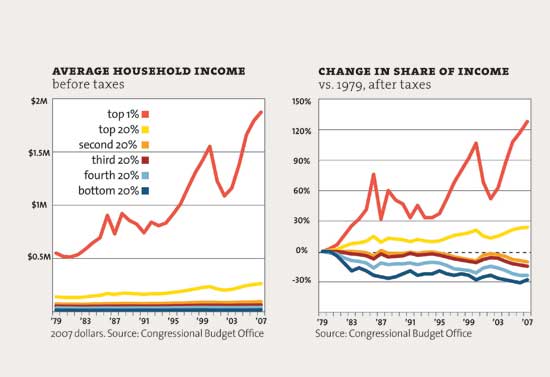
Mother Jones Magazine, a progressive investigative paper around since the 1970s, had done an interesting, though to me frightening, bit of research about the average household income from 1979 to 2007 in America. The obvious thing was that the rich in the USA had the vast majority of the wealth, something that has been found in previous research for some time. Hardly shocking, and because it has become so commonplace it hardly moves anyone to action except the most liberal.

The graph that really caught my attention though was this:

As can be seen, the growth income for the bottom 80% of the country was non-existent for about three decades, and after taxes it was negative. Conversely, the top 20% made money, even after taxes, and the top 1% more than doubled their income. It is also interesting that there appears to be a correlation between when the rich take a hit and when the lower income levels go up, but without actually analyzing the raw data I can't say if this is statistically significant--that is, a real result or an artifact of my eye.

I can't think of better data that disproves the supply-side economics slogan that rising waters lifts all boats. When 80% of a country can get poorer while the GDP grew on average throughout this same period, that is a model worth setting out to sea.

On the other hand, there are empirical facts that show that income disparities actually hurt economies. This has been shown by researchers Roberto Perotti (“Growth, Income Distribution, and Democracy: What the Data Say”, Journal of Economic Growth 1(2) (1996): 149-187) and some at the World Institute for Development Economics Research. The same research also finds that high equality rates can be damaging as well, which explains by communist systems have been historically problematic.

What this means is that the current model of giving more tax breaks to the top 1% in this country is not going to bring salvation but only exacerbate the problem. Besides, if the poor keep getting poorer, then they cannot afford the products of the super-rich, and having the majority of your potential market kept out due to income disparity is going to hurt in the long run. Also, the way many in the US have been able to increase their standard of living is increasing their debt, and that won't work indefinitely as well.

Unless there is a significant change in policy about taxation, and one that is the exact opposite of libertarians and Tea Party activists, the middle class and poor are only going to get squeezed more and more. But I have great difficulty fathoming how 80% of the nation can get less well off and think tax breaks for those outside above their income bracket will be their salvation. It hasn't worked now from 30 years. What's it going to take?

Saturday, February 26, 2011

The Miracle-Free God of the Bible

Perhaps I need to pay more attention to the Old Testament prophets, because it looks like there are some interesting gems there.

A blogger, Joel Watts, a theology student has come up with a great passage from the Old Testament that can be quite the dirge against literalist creationists. He noted in Jeremiah 31:35-6 that God says he would not circumvent the regularity of nature lest he end his covenant with his people Israel. Now, he doesn't believe that one should take the whole thing literally, as there are miracles in the Bible, but that's the whole point! If you are a literalist, this passage will contradict a miraculous creation; if you want a miraculous creation, you have to not be a literalist.

Will this convince any Young Earth Creationists? I doubt it, but it is one more example of why students of the Bible are so much more interesting than those that only act like they are Bible lovers.

Tuesday, December 14, 2010

No Star of Bethlehem--Thus Spake Zarathustra

In a previous post, I began a critique of one recent attempt to explain the Star of Bethlehem as a natural phenomenon, namely a comet. There I showed that in the land in which the Magi were likely to have emerged from, comets, like in most all other cultures, are considered evil omens.

However, one should ask what we know about the Magi and what we know about their interests in astrology. After all, if we are trying to figure out what would have been interesting in the skies to these eastern sages, we need to know what they thought of events in the heavens.

Firstly, the term magos in the Roman world would have meant something other than the peoples of Persia, and it was often used for astrologers in general or various diviners or magicians. In fact, our term 'magic' is derivative of the Greco-Roman term. Also, Christian figures such as Justin Martyr stated that the Magi were from Arabia. Now, this may have been because of his understanding of Isaiah 60, where gifts brought to the Jewish king by various members of regions close to the Holy Land are mentioned, along with a great light. However, Matthew seems to imply that the Magi are in fact from the Parthian Empire. Firstly, the term magos appears in only one book in the Greek Old Testament, in the Book of Daniel. Thus, a reader living in an environment that was dedicated to the holiness and importance of the OT would place the Greek term in the context of eastern soothsayers from the Babylonian Empire. Furthermore, Matthew calls them magi "from the East", which would point in the direction of Babylonia/Persia far more than to Arabia, and this would also distinguish the Magi from the hucksters of the time in Imperial Rome. Thus, it
seems best to think of these Magi as the ones mentioned from the East, especially as mentioned by figures such as Herodotus and Strabo.

Now, the magi were the priests of the Zoroastrian faith, one that is considered even more ancient than that of the Hebrews (Mary Boyce placed the prophet Zoroaster in about 1200 BCE). Also, the Zoroastrians had a cosmic dualistic theology, that there were two
principle gods, Ahura Mazda (the good), and Ahriman (the evil). These are the Avestan names of the deities, and later languages would show modification in the names (compar YHWH to Jehovah). Also, most all our texts for the faith come in later centuries and didn't reach the form we know them until the Sassanian period. Nonetheless, we can learn a fair bit about their beliefs from their texts, along with comparing classical sources, though we must be cautious concerning their quality.

Now, what do we know about Zoroastrian astrological beliefs? (My discussion here is primarily based on that of Gerard Mussies, “Some Astrological Presuppositions of Matthew 2: Oriental, Classical and Rabbinical Parallels” in van der Horst, Aspects of Religious Contact and Conflict in the Ancient World, pp. 25-44.)

From what we can gather, firstly, Greek astrological methods did not become well-known in Persia until the Sassanian period, especially under leaders such as Shapur I who instituted programs to gather and translate Greek and Indian scientific works, namely in areas such as astronomy and astrology. That this translation effort in Pahlavi does not come to be until this time suggests a lack of interest in the sort of astrology one finds in the works of Ptolemy. This of course does much to harm the theories of researchers such as Michael Molnar who depend on their interpretation of horoscopes using Greek treatises. But what is more damning is what Zoroastrians had to say about the main edifice of astrology: the planets.

According to the preserved texts, in the beginning Ahura Mazda had the stars, Sun, and Moon as stationary objects giving off their light, a sign of their purity. Also important where the constellations, especially those of the zodiac. However, Ahriman corrupted the heavens as much as he could, and caused some of the bodies in the sky to move and attack the other uncorrupted bodies. Thus the planets, the wandering stars, were evil, the product of the Evil One. Along with the the five classical planets were the eclipsed Sun and Moon (the normal Sun and Moon were still good), the comet Mush Parig, and the lunar nodes called Goshihr. The key thing is that changing bodies were the corrupted, which those that were regular such as the stars and the normal course of the Sun and Moon were pure and good.

Thus we see in the holy texts a very negative view of the planets. In other texts, we find Zoroaster himself debating with Babylonian scholars about the meaning of heavenly bodies, which implies the debate going on in Sassanid Persia rather than an historical recollection--this of it as a sort of WWJD story, but instead WWZD. We also get a sense for how late this debate is because the most ancient texts, the Avesta, speaks only of major, bright stars such as Sirius, along with the Sun and Moon. The planets are not mentioned until this derivative literature is produced which is from the 3rd century CE or later. There is also no direct evidence of astrological knowledge in earlier periods, and indirect evidence is not persuasive.

What this means is that the sort of object that Matthew describes, one that moves and stops, even a comet or planet, would be considered evil. It is also likely that a supernova would be ominous because of its unpredictability. The only sort of astrology practiced by the Zoroastrian priesthood was most primitive, even when compared to what the Babylonians had done in the Enuma Anu Enlil. Thus, it would be inappropriate to call the Magi 'astrologers' as they would not have cast horoscopes or done judicial astrology. In other words, Matthew's Magi were not the right people to be interpreting the heavens.

This is a major wrench in the works for all attempts to identify the Star because any configuration of planets would be baleful to the magi, and similarly for comets or most anything else considered to be the Star of Bethlehem. Later Zoroastrians would adopt Greco-Indian astrology and make their own innovations, such as the great conjunction system of world history, but all this is centuries too late. This also goes against the historicity of Matthew's tale since his choice of astrologically-minded people is incorrect. However, since it is more likely Matthew was trying to evoke the magi of Daniel, it is likely why he chose the term; his purpose is literary, not historical, as future posts will demonstrate.